IE 4531: Lab for Manufacturing Systems & Techniques
Introduction to Cyber-Physical Factory Lab
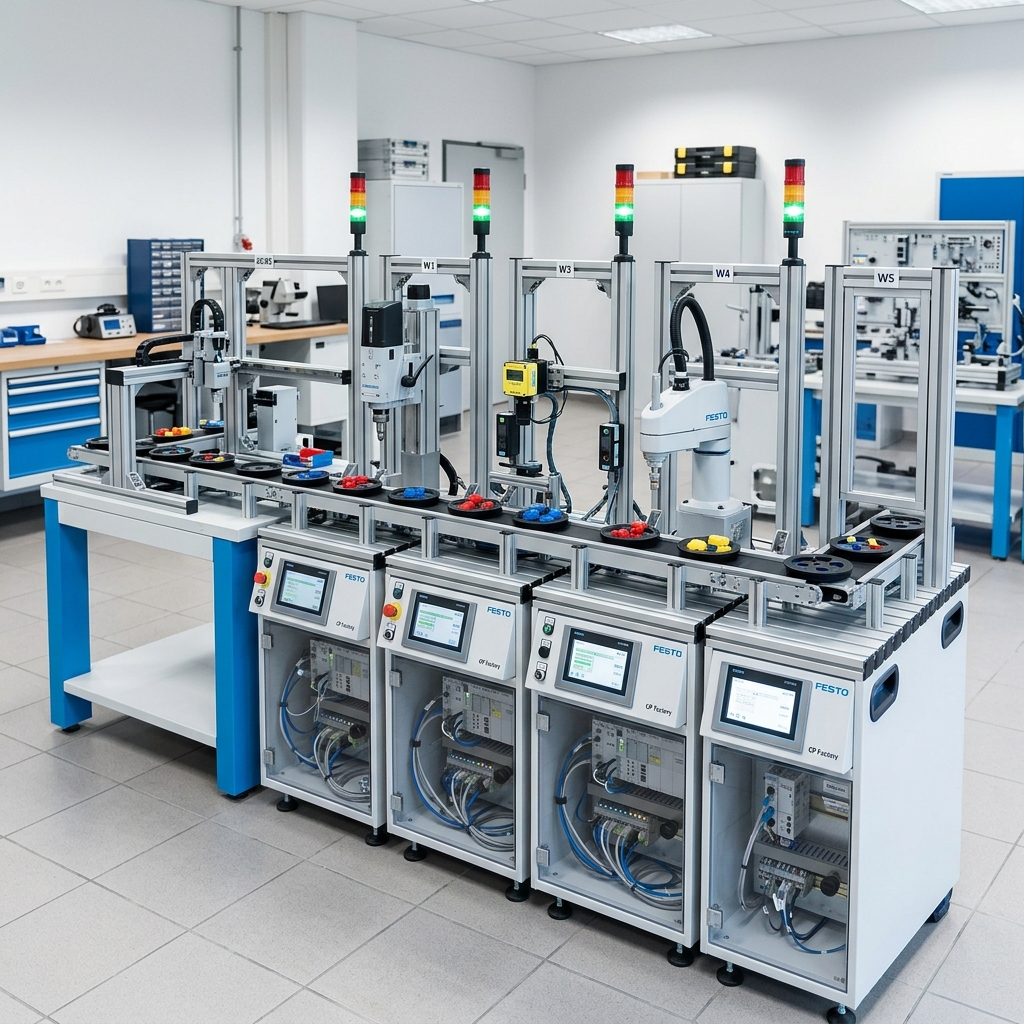
Autonomous Production Lines
From Order to Delivery: Smart Production Systems in Action
A comprehensive look at Industry 4.0 technology, modular manufacturing, and cyber-physical integration.
Supplementary Presentation
by Ajith Srikanth
Graduate Teaching Assistant, IE 4531
🔗 LinkedIn: linkedin.com/in/as31
✉️ Email: ajithsrikanth.f@northeastern.edu
"This presentation supplements the official Festo Didactic CP Factory laboratory materials and documentation"
Today's Topics
Understanding Industry 4.0 Manufacturing Systems
Flexible, reconfigurable workstations
Robots and intelligent control
Connected, communicating components
Traditional Manufacturing
Fixed layouts: Machines bolted to floor, expensive to reconfigure
Manual processes: Workers carry parts between stations
Isolated systems: Each machine operates independently
Paper tracking: Clipboards and manual logs
CP Factory Approach
Modular design: Stations rearranged in hours, not weeks
Automated flow: Conveyors and robots handle transport
Unified network: All components share data in real-time
Digital tracking: RFID and MES monitor every workpiece
🤔 What IS the CP Factory?
CP = Cyber-Physical
A factory where machines talk to each other AND the internet!
FLEXIBLE
Modular workstations enable quick reconfiguration for different products
CYBER-PHYSICAL
Physical machines integrated with digital systems and IoT sensors
NETWORKED
All systems connected through unified communication protocols
of manufacturers adopting smart factory tech by 2025
Laboratory Safety Requirements
Your safety is our top priority
Safety Glasses
ANSI Z87.1 rated
Required at ALL times. Flying debris can cause permanent eye damage.
Closed-Toe Shoes
Leather or composite
No sandals or canvas. Parts up to 7kg can cause serious injury.
Secure Long Hair
Tie back & secure
Rotating equipment can catch loose hair causing scalp injuries.
No Loose Items
Remove jewelry & secure sleeves
Rings, watches, necklaces can entangle in rotating shafts.
NEVER Touch Without Supervision
Wait for explicit permission from lab staff
All equipment operates at high forces and temperatures. Unauthorized operation can result in serious injury.
⚠️ Hazards Present in This Laboratory:
Production Workflow Example
Custom Aluminum Phone Case: Order to Delivery
1. ORDER
Material: 6061 Aluminum
Custom: "NEU"
2. PLAN
MES4 creates route:
AS/RS → CNC → Laser
3. MILL
CNC Mill shape
(8 minutes)
4. ENGRAVE
Laser engrave text
(3 minutes)
Process Orchestration
MES orchestrates this entire sequence—dispatching tasks, routing workpieces, and synchronizing data through standardized protocols. Each module reports status in real-time, enabling continuous tracking.
Total Production Time
High EfficiencyBase Modules: Material Transport Infrastructure
Conveyor-based workpiece routing system
Linear Module
Function: Bidirectional conveyor system (forward/reverse)
Branch Module
Function: Automated path splitting via pneumatic diverters
System Architecture: Transport vs. Processing
Base Modules provide: Material flow infrastructure using conveyor segments and diverters for routing
Application Modules provide: Manufacturing operations (pressing, turning, inspection) that attach to base module work positions
Key Distinction: Base modules move workpieces through the factory; they do not generate the mechanical power for machining, forming, or assembly operations
Application Modules: Processing Stations
Automated operations with independent control systems
Magazine Module
Automated feeder with pneumatic picker mechanism
Press Module
Pneumatic press applying controlled vertical force
Turning Module
Pneumatic gripper and rotary actuator
Camera Inspection Module
Vision system with 5MP industrial camera + AI
Pick by Light Module
LED-guided manual assembly with sensors
Active Control Architecture: Each module contains its own Siemens S7-1200 PLC controller, executing programmed logic independently. They receive job parameters from MES via PROFINET and report completion status back - they are intelligent workstations, not passive storage containers.
Integrated Stations
Automated storage and robotic assembly
AS/RS System
Robotic Assembly Cell
Integration = Continuous Communication
Inventory status
Retrieval commands
Part localization
Orientation feedback
Real-time status
Coordinated handoffs
Manufacturing Processes
Three primary methods
SUBTRACTIVE
ADDITIVE
LASER
Process Selection Decision Tree
→
CNC Mill
→
3D Printer
→
Laser
Material Handling Equipment
Robotic machine tending and autonomous transport
FANUC CR-7iA/L (7-Axis)
Machine tending and part transfer
Robotino Mobile Platform
Autonomous pallet transport and navigation
Coordinated Operation: These systems don't operate on timers - they coordinate with MES in real-time. When AS/RS completes a storage operation, it notifies MES. MES dispatches Robotino to AS/RS location. Robotino acknowledges receipt of command, navigates to AS/RS, confirms pallet pickup, delivers to CNC station. FANUC receives notification from MES that material has arrived, picks up part, loads CNC. This level of coordination requires continuous bidirectional communication between all components.
Manufacturing Execution System (MES4)
The central orchestrator
Four Core Functions
Order Management
Receives orders with specs, quantities, priorities
Task Dispatching
Assigns work to stations, balances load
Workpiece Routing
Directs parts through optimal paths
Data Synchronization
Coordinates via PROFINET/OPC-UA protocols
Active Control vs. Passive Monitoring
NOT Just Monitoring
Passive data collection
No control over machines
Humans coordinate
Active Orchestration
Dispatches every task
Controls all routing
Triggers all processes
CP Factory: System Architecture Summary
Integrated components and coordinated operations
Core System Characteristics
Flexible Manufacturing
Implementation: Modular workstations with standardized interfaces enable rapid reconfiguration for different product lines
Technology: Embedded sensors and controllers in each module support quick changeovers
Cyber-Physical Systems
Integration: Physical manufacturing equipment integrated with digital models, IoT connectivity, and real-time data processing
Example: RFID chips on workpieces (digital) control machine operations (physical)
Networked Manufacturing
Architecture: All systems connected through unified communication protocols (PROFINET/OPC-UA)
Benefit: Enables adaptive workflows and coordinated decision-making across the entire production system
Component Functions
Base Modules (Linear/Branch): Provide transport and routing infrastructure via conveyor segments and pneumatic diverters for flexible path control
Application Modules (Magazine/Press/Turning/Camera): Execute automated processing operations - feeding parts, applying force, reorienting workpieces, vision-based inspection
Manufacturing Equipment: Subtractive (CNC), additive (3D printing), and laser processing for part production
System Coordination
AS/RS: Automated storage that exchanges positional data and retrieval commands with upstream controllers
Robotic Assembly: UR5e uses sensors and vision systems to achieve precise, repeatable pick-and-place workflows
MES4: Orchestrates production by dispatching tasks, routing workpieces, triggering processes, and synchronizing data through standardized protocols
Integration Definition: CP Factory integration means all modules—transport, storage, processing, and robotics—coordinate through continuous communication and shared control logic, enabling unified material and data flow. This is fundamentally different from independent machine operation where each unit works in isolation without data exchange.
⚠️ CRITICAL: Lab Attendance Information
Please read carefully - this is extremely important
📅 Attendance Policy
You MUST attend the lab section you signed up for to receive credit
💯 Grade Weight
Each lab is worth 20% of your IE 4531 grade
📚 Preparation
Come prepared - refer to introduction slides for details
💬 Participation
Actively participate in all lab activities
Questions or Concerns?
We strongly encourage you to:
• Bring up any confusions or doubts in class tomorrow
• Email us at your earliest convenience
Do not wait until the last minute - we're here to help!
Important Reminder:
With only 5 labs and each worth 20% of your grade, every single lab session is critical. Missing even one lab can significantly impact your final course grade. Plan ahead and prioritize your lab attendance.
Assessment Quiz
Evaluate your understanding of today's material
Quiz Format & Coverage
📝 Format
• Multiple choice questions
• Select all that apply
• Timed assessment
• Canvas quiz system
⏱️ Time Limit
• Check remaining time:
• Press SHIFT + ALT + T
• Manage your time wisely
• Review before submitting
📚 Topics Covered:
Flexible manufacturing, cyber-physical systems, and networked manufacturing concepts
Base Modules (Linear/Branch) and Application Modules (Magazine, Press, Turning, Camera)
Integrated systems definition, AS/RS functions, and Robotic Assembly Cell operations
MES control of assembly and manufacturing processes, including robotic machine tending
Key Concepts to Remember:
• Cyber-Physical: Physical machines integrated with digital models and IoT connectivity
• Networked: Unified communication protocols enable coordinated operations
• Base Modules: Transport/routing via conveyors and diverters (NOT power generation)
• Application Modules: Active processing with automated control (NOT passive storage)
• Integration: Continuous data exchange - AS/RS exchanges positional data, robots use sensors
• MES: Actively dispatches, routes, triggers, and synchronizes (NOT just monitoring)
Ready to Begin?
Click "Proceed to Quiz" when you're ready to start the assessment
Good luck! You've got this!
IE 4531 Lab Introduction: Complete
Presentation by Ajith Srikanth
Questions about this presentation?
Feel free to reach out:
Ajith Srikanth, Graduate Teaching Assistant
CP Factory overview and Industry 4.0 principles
Base and application module functions
Integrated systems (AS/RS, robotic assembly)
Manufacturing processes (CNC, 3D printing, laser)
MES orchestration and control architecture
Mandatory PPE: ANSI Z87.1 safety glasses, closed-toe shoes
No loose clothing, jewelry, unsecured hair
Never operate equipment without supervision
Hazards: 185°F surfaces, 90 PSI pneumatics, 6000 RPM spindles, laser radiation
Week 2: Base and application modules operation
Week 3: Manufacturing equipment (CNC, 3D printer, laser)
Week 4: Integrated systems and MES programming
Key Concepts to Remember
Flexible Manufacturing: Achieved through modular workstations with standardized interfaces and embedded controllers that enable rapid reconfiguration
Cyber-Physical Systems: Physical machines integrated with digital models and IoT connectivity, creating real-time communication between physical and digital domains
Networked Manufacturing: All components connected through unified communication protocols, enabling coordinated operations rather than isolated, independent machine operation
Base vs. Application Modules: Base modules provide transport/routing infrastructure via conveyors and diverters; application modules perform actual processing operations with active control systems
Integration: All modules coordinate through continuous data exchange - AS/RS exchanges positional data, robots use sensors for coordination, MES orchestrates all activities
MES Function: Actively dispatches tasks, routes workpieces, triggers workstation processes, and synchronizes data exchange through standardized protocols - not just passive monitoring
Students may now proceed to the Canvas assessment quiz to evaluate their understanding of today's material. Review the key concepts from the previous slide if needed before starting.